
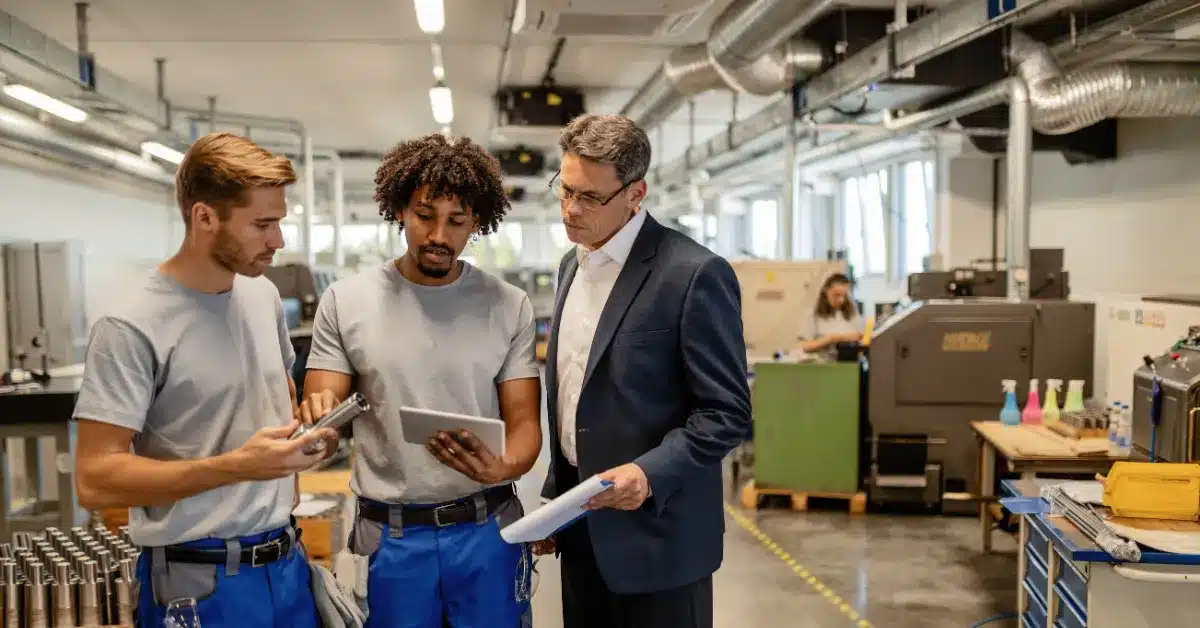
Your best equipment operator just became your worst manager.
Everyone’s focused on the “labor shortage” in manufacturing. Headlines report 3.8 million unfilled jobs by 2033. Companies invest heavily in recruiting efforts and retention bonuses.
But here’s what the data actually shows: You’re not losing people because you can’t find them. You’re losing people because you can’t keep them.
And the primary reason? Your supervisors weren’t trained to lead people.
The Problem
75% of manufacturing supervisors receive zero formal leadership training before managing people.
We promote based on technical expertise and expect leadership skills to develop naturally. Your best equipment operator becomes a supervisor and now they’re responsible for handling conflict, providing feedback, and motivating a team. Without training, they default to avoiding difficult conversations, micromanaging, or treating all performance issues the same way.
The result is predictable. Good employees leave. Not for higher compensation or better benefits. They leave because poor supervision makes work frustrating and demoralizing.
Manufacturing research shows communication failures and supervisory issues cause more unplanned downtime than equipment failures.
Your untrained supervisors may be creating more operational disruption than mechanical problems.
What Separates High Retention Companies from High Turnover Companies
We work with manufacturers facing identical labor market challenges. Same industry, same geographic area, similar compensation packages. Yet some struggle with constant turnover while others maintain stable, engaged teams.
The difference comes down to supervisor development.
Companies that retain talent do three things consistently:
- They train supervisors before problems escalate Proactive development rather than reactive damage control.
- They use training designed for manufacturing environments Practical skills applicable to production settings, not generic corporate leadership concepts.
- They make training operationally feasible Modular content, flexible scheduling, and virtual options that don’t shut down production.
Our Framework
Our Front Line Leadership program addresses exactly what manufacturing supervisors need. The program focuses on the essential leadership skills that directly impact retention and performance.
Supervisors learn how to understand their role as a leader rather than just a technical expert. They develop communication effectiveness skills for having direct, productive conversations without creating conflict. They master managing different personalities using practical frameworks like DiSC assessment. They gain coaching abilities to develop their team members while managing performance issues constructively.
The program is designed for manufacturing environments with 4-hour modules that can be delivered virtually without shutting down production. Each session provides tools supervisors can implement immediately on the floor.
One automotive client experiencing monthly departures among experienced operators implemented our Front Line Leadership program after exit interviews consistently cited management issues. Turnover decreased 40% within six months while safety performance improved.
The Advantage of Better Supervision
Manufacturing faces unprecedented workforce challenges. Retiring baby boomers, increased competition for skilled workers, and rising expectations from younger employees.
Organizations that develop supervisory capability will have a significant advantage in attracting and retaining talent. Better supervisors create better work environments, which leads to better retention, reduced recruiting costs, and improved productivity.
The companies that address this systematically will be better positioned for the workforce challenges ahead.
Ready to develop supervisors who can retain your best people?
For organizational development: Our Train-the-Trainer certification allows you to build internal capability and deliver proven leadership development at scale.
For individual development: Enroll managers in individual management training courses for comprehensive virtual training they can apply immediately.
Learn how Front Line Leadership’s Manufacturing Leadership Training program can support your organization.