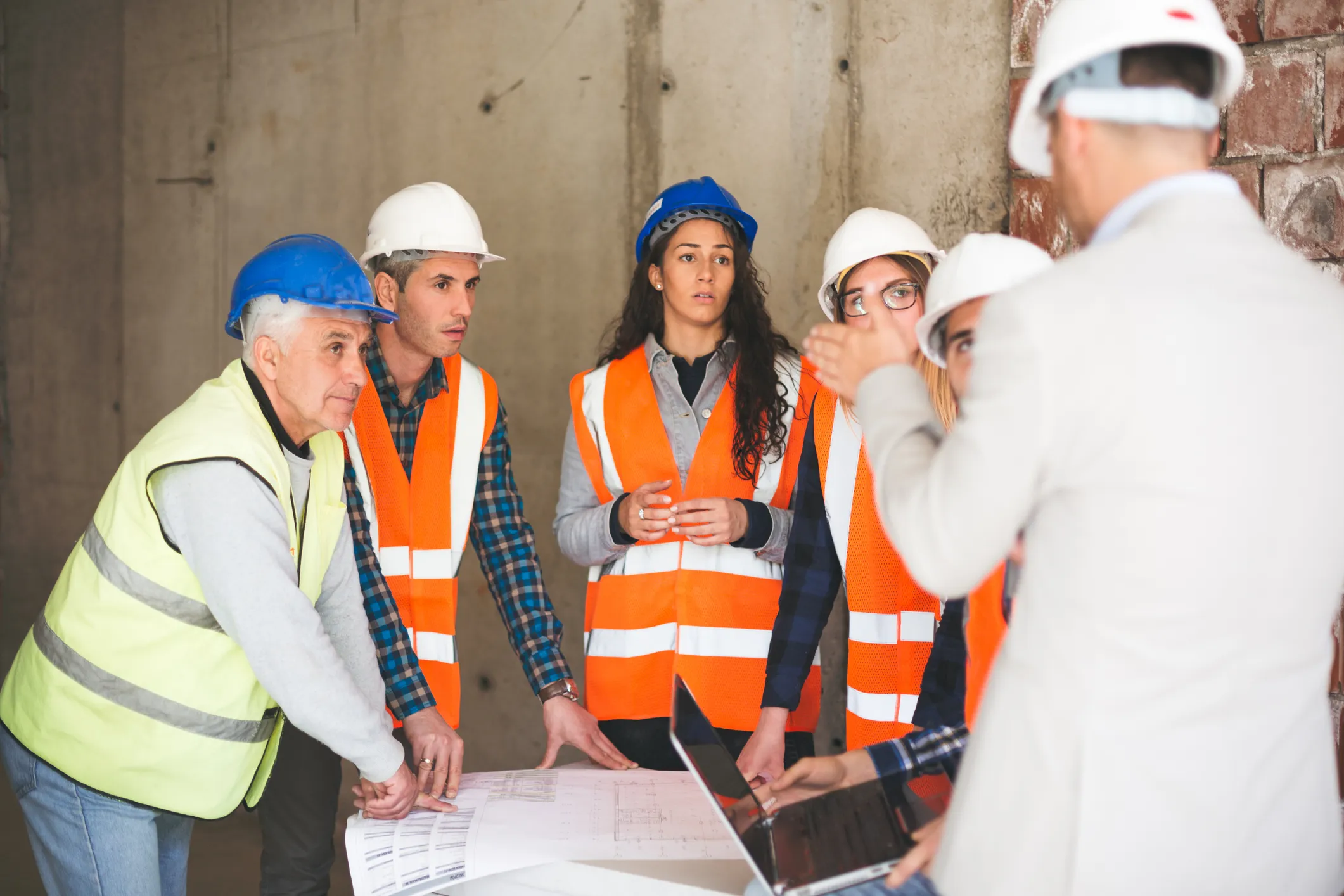
Group of construction workers, women and men wearing hard hats and safety vests, standing around a table attentively listening to a supervisor in a suit with his back to the camera, demonstrating effective team leadership on a construction site.

Meetings Don’t Have to Be Bad

Every shift starts the same way. The supervisor gathers the team for the daily meeting. Five minutes later, everyone walks away having learned nothing useful, feeling less connected than before, and wondering why they bothered showing up.

This ritual happens thousands of times daily across the country. Supervisors run shift meetings because they’re supposed to. Not because the meetings accomplish anything meaningful.

The shift meeting is either your most valuable daily leadership opportunity or your most visible daily failure. There’s no middle ground. Every team meeting either builds cohesion and alignment or demonstrates that the supervisor doesn’t know how to lead.
The Meeting Pattern That Destroys Teams

Walk into most shift meetings and you’ll see the same dysfunctional structure playing out. The supervisor doesn’t prepare. They wing it. The “meeting” becomes a series of announcements that could have been an email followed by awkward silence.

The Information Dump

“Production targets are up 10%. The safety meeting is Thursday. Don’t forget to clock out for breaks. Any questions?”

No context. No discussion. No connection to how this information affects the team. Just data transmission that treats employees like message recipients rather than thinking contributors.

Team members stop listening because nothing being said matters to their actual work. They’ve learned these meetings contain no useful information. Attendance becomes a compliance checkbox rather than a valuable interaction.

The Lecture

“We’re still seeing quality issues in Department 3. Everyone needs to follow procedures. This is unacceptable.”

The supervisor addresses the entire group about problems caused by one or two people. High performers resent being lectured about issues they didn’t create. The actual problem employees tune out because the feedback isn’t specific to them. Nobody changes behavior because nobody feels accountable.

Teams learn that these meetings are where they get blamed collectively for individual failures. They resent the time waste and the supervisor’s inability to address issues directly.

The Awkward Silence

“Any questions? Any issues?”

Nobody speaks. The supervisor takes this as agreement. In reality, employees have learned that raising concerns in the group meeting leads nowhere or creates problems. They stay silent. Real issues never surface.

The supervisor concludes the team has no concerns. The team concludes the supervisor doesn’t actually want to hear concerns. Trust erodes in mutual silence.

These patterns don’t build teams. They demonstrate supervisory incompetence and waste everyone’s time.

What Effective Shift Meetings Actually Accomplish

Organizations with high-performing teams run fundamentally different shift meetings. The meetings aren’t information dumps or lecture halls. They’re leadership tools that accomplish specific objectives.

They create shared understanding of priorities

Effective supervisors use the shift meeting to ensure everyone understands what matters most that day. Not just production targets, but why those targets matter. Not just rules, but the reasoning behind them. The team leaves aligned on priorities rather than confused about what actually needs focus.

They build psychological safety for raising concerns

Good supervisors structure meetings so speaking up feels safe. They ask questions that invite input. They respond to concerns constructively. They thank people for identifying problems. Over time, teams learn that the shift meeting is where issues get addressed rather than ignored. Real communication begins.

They recognize contributions publicly

Strong supervisors use team meetings to acknowledge specific good work. Not generic praise for everyone, but genuine recognition for actual contributions. This reinforces desired behaviors and shows the team what excellence looks like. It builds culture through visible appreciation.

They facilitate problem-solving together

Effective meetings include time for the team to discuss challenges and generate solutions. The supervisor doesn’t lecture about problems. They engage the group in solving them. This creates ownership and taps into collective knowledge. Teams develop capability to improve their own processes.

They build team identity and connection

Well-run meetings create moments where people connect as a group rather than just working alongside each other. The supervisor facilitates interactions that build relationships. Team members learn about each other. Cohesion develops through regular positive group experiences.

These meetings accomplish what shift meetings should: aligning the team, addressing real issues, building relationships, and developing collective capability.

The Skills Untrained Supervisors Lack

Supervisors run terrible meetings not because they don’t care but because they were never taught the structure and skills that make meetings effective.

They don’t know how to prepare

Effective meetings require preparation. What does this team need to know? What issues need addressing? What recognition should be given? What problems need group input? Untrained supervisors show up and improvise. Preparation makes the difference between valuable and worthless meetings.

They can’t facilitate discussion

Leading a productive group discussion requires specific skills. Asking questions that generate input. Managing dominant talkers and drawing out quiet contributors. Keeping discussion focused. Synthesizing ideas into actions. Without facilitation training, supervisors either lecture or lose control.

They don’t understand group dynamics

Teams have personalities and patterns. Effective supervisors recognize team dynamics and adapt their approach accordingly. They know which topics create conflict and how to navigate them. They understand how to build safety so people speak up. This awareness comes from training, not instinct.

They lack a clear structure

Good meetings follow a predictable structure that accomplishes objectives efficiently. Untrained supervisors meander through topics randomly. Time gets wasted. Important issues don’t get addressed. Teams lose patience with the disorganization.

They can’t translate strategy into daily relevance

Supervisors receive information from upper management and need to translate it for their teams. This requires understanding what frontline workers care about and connecting organizational priorities to their daily experience. Without this skill, company communications feel disconnected from reality.

Research on team effectiveness shows that regular, well-run team meetings are one of the strongest predictors of team performance and cohesion. Conversely, poorly run meetings actively damage team dynamics and supervisor credibility.

Our Framework for Effective Team Leadership

The Front Line Leadership program includes specific training on building and leading high-performing teams through the Teamwork and Collaboration module.

Supervisors learn the characteristics of effective teams and how to assess their current team’s strengths and weaknesses. They experience the G.R.O.U.P.S. model that identifies six components of team effectiveness. They develop facilitation skills for running productive meetings that engage rather than alienate. They gain communication techniques for building psychological safety so team members actually speak up.

The training addresses the practical reality of leading shift teams in manufacturing environments. No generic corporate team-building theory. Just proven frameworks for the specific challenges frontline supervisors face daily.

Participants practice the skills during training. They return to their teams with clear structures for running effective shift meetings and specific techniques for building team cohesion through regular interactions.

One automotive supplier had consistently poor team dynamics across multiple shifts despite individual operator capability. After implementing Front Line Leadership training that included team development skills, supervisors began running structured shift meetings that actually accomplished objectives. Team performance metrics improved and inter-shift competition decreased as teams developed stronger internal cohesion.

What Changes When Supervisors Learn to Lead Teams

Organizations that develop supervisors’ team leadership capability see benefits that extend far beyond better meetings.

Shift meetings become opportunities to align priorities, surface issues early, recognize contributions, and build relationships. Teams develop cohesion and identity. Communication improves because people feel safe raising concerns. Problems get solved faster because collective intelligence gets tapped.

Most importantly, supervisors build credibility through demonstrable competence. Teams respect leaders who can run effective meetings and facilitate productive group interactions. This respect translates to better follow-through on direction and higher engagement overall.

The shift meeting transforms from a waste of time to the most valuable 10 minutes of the workday. That transformation happens when supervisors gain the skills to actually lead teams rather than just supervise individuals.

Manufacturing success depends increasingly on team performance rather than just individual excellence. Organizations that develop supervisors who can build and lead effective teams gain measurable advantages in productivity, quality, and employee retention.

Stop wasting time in useless shift meetings.

Our Winter 2026 Cohort starts January 22nd and includes the team leadership frameworks that transform shift meetings from time-wasters into team-builders. Give your supervisors the skills they need. Deadline to register is January 8.

Register now: https://frontlineleadershipprogram.com/events/winter-2026-cohort/